Repair Rust and Rust Holes on Your Car
🔩 Repair Rust and Rust Holes on Your Car
Professionally treat rusted areas, fill and paint
Difficulty
Challenging
Time
5-8 Hours
Cost
€200
Savings
€1000
Tools
Grinder, Hand Tools
Video Tutorial Step by Step
🛒 Matching Product for This Video
[dasauto_product id=“368831″]
The Problem
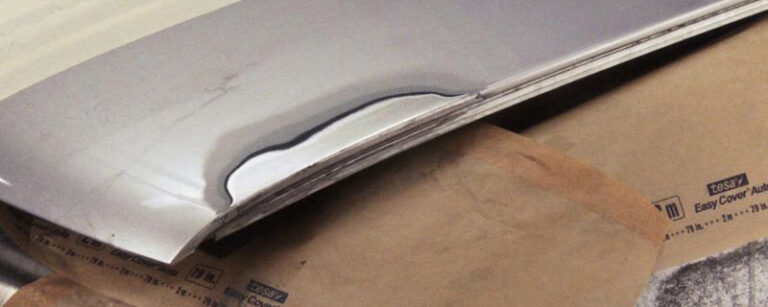
Eye-catching, perforated, large-scale rusted body. Nobody wants to drive it anymore, but nobody wants to throw it away either because the car is technically still in good shape.
⚠️ Warning
Rust holes on load-bearing parts such as sills, underbody struts and longitudinal members must never be filled with filler. These damages must be welded by a professional.
Here’s How:
Remove Rust
Get rid of the rust and repair the body yourself.
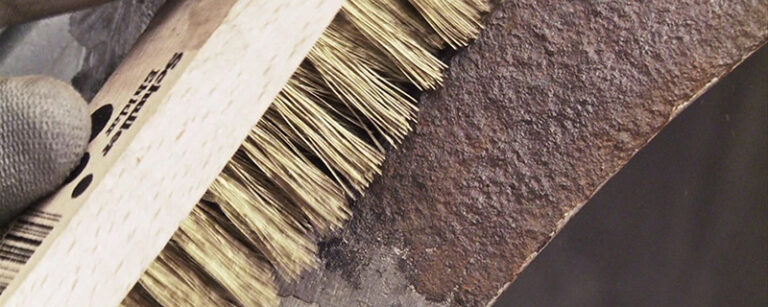
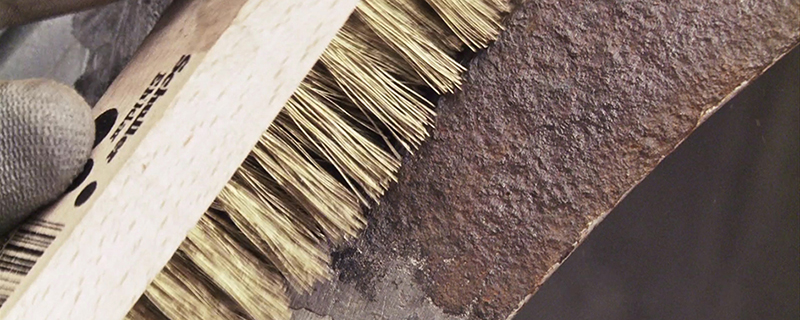
Completely remove rust, protruding loose metal parts and flaking paint layers. Wrap dry sandpaper – coarse grit P60 – around a sanding block and sand the rusted areas down to bare metal over a large area.
Not a bit of rust must remain visible on the car. Where there was rust before, it must now shine brightly!
Then clean the area very thoroughly with silicone remover.
💡 Pro Tip
It’s easier and faster with a grinder or cordless drill with attachment. This works great, is more fun and saves enormous time. Three minutes with the grinder saves 20 minutes of tedious manual work. Protect all parts that should not be sanded with masking tape.
Filling
Fiber filler can now be applied to the shiny, perfectly sanded and silicone remover-cleaned area.
Fiber filler (filler with polyester fibers) adheres superbly to metal and is stable on its own due to the fine fibers.
Here’s how: Spread fiber filler on a piece of cardboard and add hardener. The correct dosage is important. If you use too much hardener, the filler sets too quickly and can no longer be worked, if you use too little, it won’t cure. Max shows you how to do it right in the video.
Apply the filler generously over the perforated area.
Sanding
After 30 minutes the filler has cured and you can sand off the excess filler dry with coarse sandpaper, restoring the original shape of the body.
Protect everything that shouldn’t be primed and painted from overspray again!
Simply use masking paper and masking tape (see video).
Fine Work
After everything is sanded flat, level any remaining craters and sanding marks with filler or spray filler.
Shake the spray can long and vigorously until the components in the can are well mixed (about 5 min). The small ball in the can must move easily and freely.
Attach the handle to the can. It works like a spray gun and makes the work much easier.
⚠️ Warning
Primer, filler and paints are harmless according to manufacturers, but certainly not meant for the lungs – so always wear a protective mask!
Priming
Now spray the filler in several thin coats (3-5). Let it flash off for 2-3 minutes between spray passes.
The ideal spray distance is 30 cm, the ideal temperature 15 to 20 degrees.
30 minutes after the last spray pass, the filler has cured and the excess can be sanded off with wet sandpaper (P500), sponge and a bucket of water (see video).
Careful work is very important here, all unevenness must be sanded flat.
Feel is important! Don’t sand through to filler or metal, otherwise these areas need to be primed again.
Painting
Once the primer is applied, dry (after about 20 min) and sanded, it’s finally time for paint on the metal!
Shake the paint spray vigorously for 5 minutes until the ball is audibly hitting and everything is well mixed. Attach the handle and apply several thin coats.
The ideal spray distance is 30 cm, the ideal temperature 15 to 20 degrees.
Caution! Don’t spray too much at once, otherwise you’ll get runs… In the video, Max shows step by step how to do it right.
Clear Coat – Top Coat
After about 30 min. drying time, the clear coat goes over the paint layer.
Shake the clear coat well too and apply in several thin coats (should be at least 5), letting it flash off after each spray pass.
The clear coat protects the metallic particles from oxidation, gives the paint gloss, and is absolutely necessary as a protective layer.
Caution! With solid colors, no clear coat is required. If unsure, email info@dasauto.at or call the hotline.
Almost Done
From the outside, your car is now back in top shape, but on the inside of the bare-sanded areas, the metal is now susceptible to new rust.
Therefore, you must absolutely preserve this area.
Very good results are achieved with cavity wax. Cavity wax is the simple, ideal solution for preservation and cavity protection.
After about 1 hour of drying time, the clear coat is hard enough to remove the masking paper.
…and – Voila! The result speaks for itself!
Done?
If you now find small edges or transitions in the paint, that’s no problem: After 2 to 3 days the clear coat is completely cured and the edge is simply carefully removed with P2000 wet sandpaper and then polished to a high gloss.
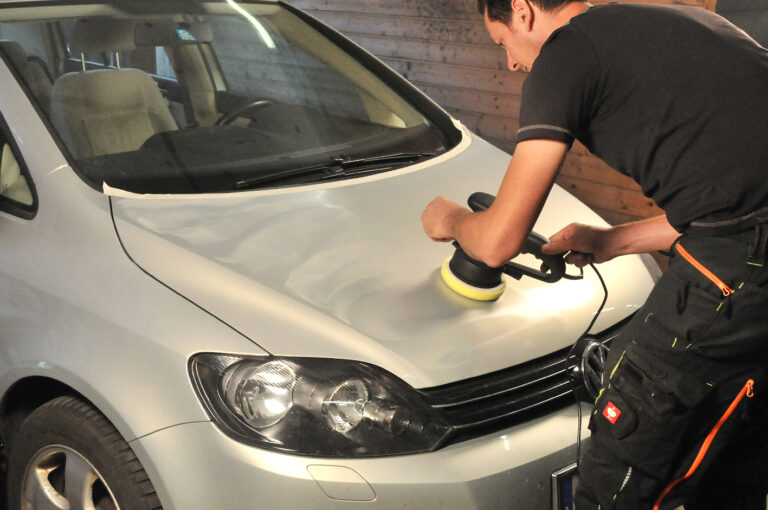
Of course, you’ll now polish the entire car and preserve it with hard wax.
💡 Important
Rust always spreads underneath the paint. Remove more than you see – rust must be 100% gone!